Laine Nooney
  • home
  • The Apple II Age
  • About
    • Teaching
    • CV
    • Prospective Ph.D.
  • Talks and Writings
  • Projects
    • ROMchip
    • Sierra On-Line Memories
    • Mistakes Were Made
    • Softalk Open Discussion Project
    • Academic Coach Taylor
    • JVC Meme Issue
    • T42 Documentary
    • Different Games Conference
    • Freelance Graphic Design

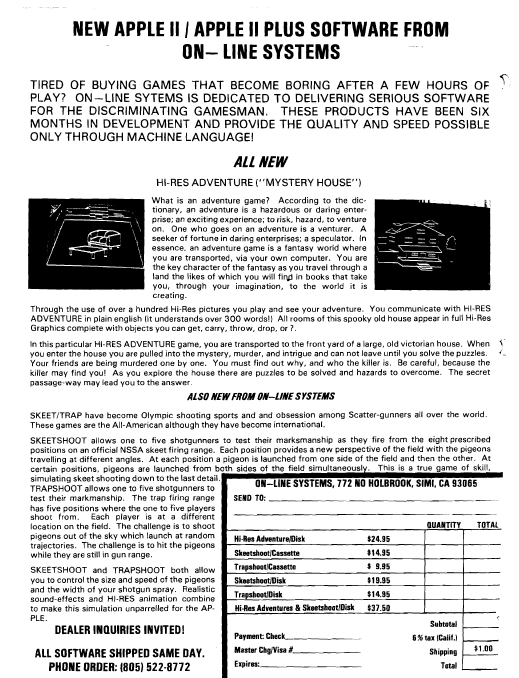
Archive Fever: The Original "Mystery House" Ad from MICRO 6502, May 1980

8/16/2013

 
Much referenced but never actually seen is the original ad Roberta and Ken Williams took out as On-Line Systems for Hi-Res Adventure: Mystery House, in the May 1980 issue of MICRO: The 6502 Journal. The 6502 was the microprocessor used in the Apple II, which was the machine On-Line initially produced all their products for during their first couple years in operation in the early 80s.

While some sources claim it was a quarter page ad, we can clearly see that it was a full-page piece. From the extensive text to the prices to the almost entirely unknown two other arcade games sold alongside Mystery House (Skeetshoot and Trapshoot), there's lots to chew on here. I'm not one for "Holy Grails" of game history, but...I must admit to certain fascination with this ad. It's a pleasure to put this back in circulation. 
Picture

An Inclusive Call: CFP SCMS 2014 // Debugging Game History: Forgotten Histories

6/30/2013


Call for Papers // SCMS 2014 Panel
Debugging Game History: Forgotten Histories

I'm seeding this call for the Debugging Game History panel, proposed for SCMS 2014. The panel is co-organized and co-chaired by Raiford Guins and Henry Lowood. 

Their panel last year was a real delight. This year, the organizers are looking to continue with rigorous scholarship, while expanding the range and diversity of both topics and participants. I strongly encourage those who might identify with or work on "marginal," de-centered areas within game history to apply. The call is dramatically explicit in seeking: "a greater sense of inclusiveness in game studies by focusing on neglected or forgotten historical actors, designs, developers, companies, scenes, players, forms of documentation, etc."

You should feel welcome to email the organizers with any questions. 

Panel Call: Debugging Game History
The panel theme is: Debugging Game History: Forgotten Histories. Each speaker on this panel will present on a key concept, player community, game developer, or topic. As with last year’s "Debugging” panels and the upcoming Debugging Game History volume, we would like each paper to be given a short title that focuses directly on the historical topic covered. 

The goal is to underline participation in a coherent project with two aspects: (1) developing critical terminology in game studies; and (2) fostering a greater sense of inclusiveness in game studies by focusing on neglected or forgotten historical actors, designs, developers, companies, scenes, players, forms of documentation, etc.  Some examples: "Arcade Art” "Clan PMS,” "Purple Moon,” "Jerry Lawson,” "Game Fanzines,” "Multiplayer Gaming before DOOM.”  These examples are just intended to give a sense of breadth and the goals of the panel; we hope to get exciting proposals on any related topic. The panel might work best if the concepts are at least somewhat related; our suggestion to achieve this would be to focus on people (players, developers) or settings, but a more diverse set of contributions is fine, too.

Bottom line: The panel's goal is to open up terminological discussion in critical-historical game studies and to break a path that opens up game studies to previously neglected histories.

Please submit proposals for panel papers to Henry Lowood ([email protected])  and Raiford Guins ([email protected]) by 10 August.

Games Aren't Art: A Response (Or, Why We Need to Stop Having this "Debate")

3/24/2013

 
Very recently, a professor from years past posted an article link on my Facebook wall and asked me whether or not I agree with the argument being the made. The piece in question was Liel Leibovitz's "MoMA Has Mistaken Video Games for Art." You can read it here.

I won't summarize the entire argument, as you can read it for yourself, but the crux of Leibovitz's argument is that games are not art because they are code. As Leibovitz puts it, "[...] a few lines of code aren’t an artistic statement, but rather an action-oriented script that performs a specific set of functions. And there are only so many functions computers know how to do: While art is bound only by its creator’s imagination, code is bound by the limitations, more numerous than you’d imagine, of computer comprehension."

Let me be frank: I am a person who doesn't care at all about whether video games are "truly" art. I might be interested in games as an aesthetic experience, but "Art" as deployed in these sorts of debates is always about trying to erect some sort of taste-based bastion around certain types of things. I find that in almost all cases, "debates" around this question are always about something else: anxieties about changing technological and aesthetic landscapes; the desire for one's hobby/obsession/fetish to be taken "seriously"; an effort to acquire funding for one's aesthetic exploits, etc. The specter of art seems to be raised with little attention to the fact that art is not a freely floating transcendental signifier bestowed by god upon appropriately sincere, lovely or serious objects. And this is the same sort of looseness I see in Leibovitz's essay. 

So, as copied almost directly from my Facebook rant, this is my response to both Leibovitz's essay and the nay-sayers of this debate more generally:

  1. The ontological status of a game cannot be reduced to its code. Games are condensations, assemblages, systems, networks--pick your metaphor/theorist--of many components. My counter to Leibovitz's proposition that games = code would be a riff on "if a tree falls in the woods": "if an instruction set exists, but no one is there to play it, is it still a game?" While code is a foundational asset of digital games, it is not *all that a game is*--even platform studies theorists would agree to that. Leibovitz only talks about 2 components of games: representation and code. This overlooks: interface, hardware, control input/output systems, users, social systems of play, institutions that distribute gaming hardware and software, as well as packaging, advertising, design and that ever tricky "culture and context." What is being posited here is an argument about computational primacy that is highly reductivist, and I would even argue masculinist in its attempt to ontologize games as a single knowable thing. To paraphrase Raiford Guins, in his recent SCMS presentation, if all we talk about in game studies is code, then we're not going to have much to talk about in coming years as file formats become inaccessible, technologies obsolesce, and games succumb to bit rot. Furthermore, several "monuments" in the history of games had no code all--including Tennis for Two which was computational but was not code-based, as well as Ralph Baer's Magnavox Odyssey. 
  2. Other code-based aesthetic forms are accepted as art. Software art, glitch art, net art, procedural art and other "code-based" artistic forms are generally accepted as forms of art in contemporary museums/galleries. I am not an art historian and cannot go into tremendous depth here, but it seems Leibovitz's argument would undermine years of work being done by contemporary digital art historians, as well as folks like Nick Montfort who've brought attention to the aesthetic contributions of ludic software (as Montfort discussed in great detail in Twisty Little Passages). If code is the basis of what is and isn't art, what is Emily Short's Galatea (or any interactive fiction, for that matter)? Corey Arcangel's Photoshop prints (essentially manipulations of code, output as color data)? Machinima (which has both its populist and more avant-garde forms)? Hell, even digital photography would seem to be circumspect if something being code ergo prevents it from being art. Leibovitz's claim that "art is bound only by its creator’s imagination" seems rather naive, given the fact that most artists work within the limitations and affordances of a medium, to say nothing of non-aesthetic or non-medium-specific limitations such as race, class, gender, sexuality--the way one's horizon of "imagination" is shaped the process of living.
  3. Such arguments misunderstand the aesthetic and cultural mission of MOMA. Whenever these debates about "are games art?" comes up, the same props of a generic, Eurocentric, canonical art knowledge are summoned. "Is Zelda the Mona Lisa?!" some gasps. "Can you compare Pac-Man to Picasso?!" another cries. These arguments turn cultural complex art objects into scaffolding for a vacant, under-interrogated, and utterly Westernist aesthetics debate. I always wonder if complainants have ever strolled through MOMA's exceptional design wings, which indicate MOMA's commitment to collecting all manner of aesthetic objects. I've seen shows on everything from typography to kitchen appliances at MOMA, and no one is losing sleep over whether the Bodoni font should be down the hall with a Francis Bacon. MOMA attempts to collect the strongest showings of our contemporary aesthetic heritage (whether is succeeds in this is another matter)--but I think this would be a better vocabulary to throw around than "art," and one which I actually do believe video games have a stake in. 
<<Previous
Forward>>

    RSS Feed

    Archives

    March 2020
    February 2020
    August 2019
    September 2017
    November 2016
    March 2016
    May 2015
    September 2014
    July 2014
    June 2014
    April 2014
    November 2013
    August 2013
    July 2013
    June 2013
    May 2013
    March 2013
    February 2013
    January 2013
    December 2012
    November 2012
    October 2012
    September 2012
    August 2012
    June 2012
    May 2012
    April 2012

    Categories

    All
    Academia
    Adjunct
    Advertising
    Advice
    Archives
    Broderbund
    Computers
    Conferences
    Different Games
    Diversity
    Ello
    Ergonomics
    Exercises
    Facebook
    Feminism
    Gaming
    Graphic Design
    History
    Illustration
    Inclusivity
    Lunenfeld
    Mass Effect
    Materialism
    Media Archaeology
    Mindfulness
    Objects
    Presentation
    SCMS
    Shot
    Sierra
    Sierra On Line
    Sierra On-Line
    Social Media
    Software
    Stony Brook University
    Syllabus
    Teaching
    Tennis For Two
    Video Games
    Visual Culture
    Visual Culture Association
    Weirdoarchive
    Whgsc
    Writing

ping me: laine [dot] nooney [at] gmail [dot] com 
skeet me: @lainenooney.bsky.social
For speaker inquiries, please contact Molly_Grote [at] press [dot] princeton [dot] edu
​
© 2026 Laine Nooney.
  • home
  • The Apple II Age
  • About
    • Teaching
    • CV
    • Prospective Ph.D.
  • Talks and Writings
  • Projects
    • ROMchip
    • Sierra On-Line Memories
    • Mistakes Were Made
    • Softalk Open Discussion Project
    • Academic Coach Taylor
    • JVC Meme Issue
    • T42 Documentary
    • Different Games Conference
    • Freelance Graphic Design